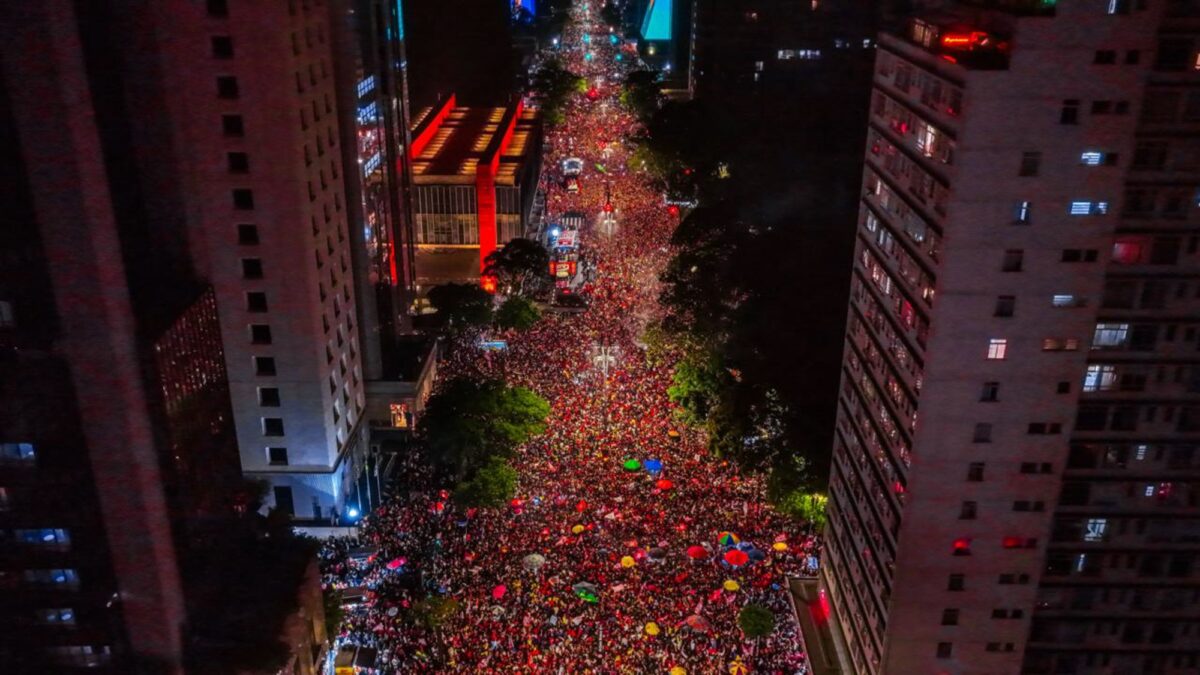
Lula’s victory opened a path of hope, built on popular mobilization, to replace the sterile and counterproductive trend of exploiting resentment and hatred for political gain.
By Marcelo Zero
What happened in Brazil in this second round of the election was historic.
It was not just an electoral victory.
It was the start of a national and international movement of popular resistance to fascism, the far right and the brutal, lawless imperialism imposed by the government of President Donald Trump.
All over the world, the “L” in Lula has taken on a new meaning.
It means that people, especially the most neglected, can hope to fight successfully against the growing erosion of the welfare state, the stripping away of social and economic rights, and the grim prospect that future generations will have worse lives than past ones.
Until this election, the dissatisfaction and hopelessness created by growing social malaise were being channeled heavily into neofascist movements, under the misnamed “populism of the right.” Those movements dominated social media. They pushed the view that the answer to this malaise lay in political authoritarianism and economic individualism.
As a result, in many countries, including Brazil, neofascist movements became “normalized” in democratic contests. This worsened economic and social problems and put democratic institutions at serious risk.
At the same time, this came with an attack on public international law, world trade rules and multilateralism (which is nothing more than democracy on a planetary scale). The result is a Hobbesian world founded on the interests of the US far right and based on the reckless use of force with no legal or moral limits.
Those who defend democracy, progressives and the left watched all of this, by and large, with a sense of powerlessness and growing fragility.
No more. I believe, without fear of exaggeration, that Lula’s victory was a “turning point” in this trend. It is inspiring progressive and democratic forces not only in Brazil and Latin America but across the planet.
Lula’s victory opened a path of hope, built on popular mobilization, to replace the sterile and counterproductive path of exploiting resentment and hatred for political gain.
It reclaimed politics and democracy, from the pavement of the streets to the digital rooftops.
But this fight has only begun. We planted the seed, but it must germinate.
What Gramsci called the struggle for counterhegemony begins again, renewed, at a higher historical level.
It is the struggle to prevail, in a peaceful contest of values, culture and intellect, over the hegemony of those who bet on inequality, resentment, antipolitics and authoritarianism.
We will only be able to govern if we deepen this fundamental struggle.
The fight of hope against hatred goes on. But the victory of Lula and the Brazilian people has opened a worldwide door that will not be closed again. The fugitives and criminals jumped out of a window that has now shut.
We won. We will win.