by Charlie Prado
On October 9th, five days after Flávio Bolsonaro took a surprise lead in the first round of Brazil’s presidential election, pop star Anitta took to her instagram account to eloquently and passionately explain to her 61 million followers why she was supporting Lula in the second round runoff on October 25. Speaking unambiguously, the popular artist powerfully slammed Bolsonarismo’s “idolatry toward a foreign country, inciting people to fight, fanaticism for the U.S. government, to the point of handing over our country and all our wealth to a guy who doesn’t give a shit about Brazil or the Brazilian people.”
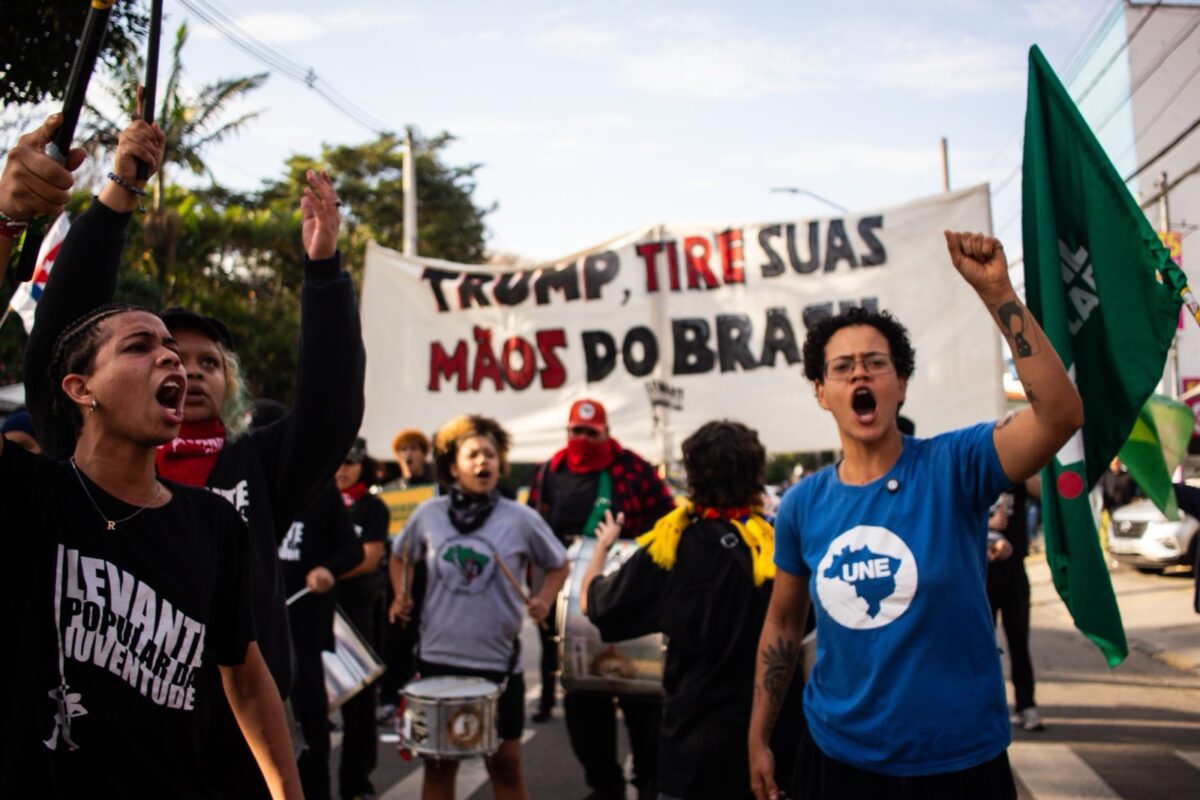
Her statement came against the backdrop of a wave of nightly student-led street mobilisations which swept across the country every day since the first-round vote. It was clear on the ground that this was a new moment. It was Brazilian youth’s primal scream in defence of its own future; a generational stand against technofascism, gangsterism, and recolonisation by the United States.
Projected on the wall of a tower block as a crowd of students passed in downtown São Paulo: “Lula is disputing an election with the son of a man who planned to kill him, don’t normalise this.”
The demonstrations grew through the weeks between the first round and the October 25th runoff, as did Lula’s standing in the polls. Everyone knows that if Lula turns this around, as some expect (and many more hope), any scenario in the aftermath will not be straightforward. There is no guarantee that the Trump administration will accept the defeat of their candidate, in whom they have invested so heavily.
In 2022 many believe that, had Trump been in office, Jair Bolsonaro’s attempt at a coup would’ve succeeded with US involvement. It is never the wrong time to remind that this coup plot for which Jair Bolsonaro and his military accomplices were jailed for decades, included the assassination of Lula, his vice Geraldo Alckmin and the then head of electoral court, Alexandre de Moraes. It also included a planned camp for political prisoners, leftists, journalists and academics that they nicknamed “Auschwitz”. 30,000 people were reportedly targets for such repression.
On the other hand, the 2022/23 coup may well have been unnecessary, as they would’ve managed to rig the election with US support – as they are attempting now – principally through manipulation on Meta social media platforms. Meta had a significant role in the previous 3 elections too, but only in 2018 with the Trump administration in office did it result in an election victory, against a substitute candidate for the then-jailed Lula.
This time around at least, Brazilians know what a Bolsonaro government looks like, and many who do not support Lula and the PT will vote for him regardless to prevent a national catastrophe that could prove to be even worse than 2019-23, with congress and senate under the far right’s near majority control, and the United States trying to consolidate control in the hemisphere through election of puppet leaders like Bolsonaro, put in power by specialist election interference operatives like Argentine Fernando Cerimedo and Trump’s own Brad Parscale, who is advising the Bolsonaro campaign.
This is of course no normal election, and neither are the stakes. Beyond the sanctioning of Supreme Court judges and their families, intended to intimate them out of prosecuting US stooges in the country, classification of crime groups CV and PCC as terrorists and a risk to US national security threat is an explicit threat of military intervention in Brazil as has happened elsewhere on the continent.
Brazil’s Intelligence agency Abin and Foreign Ministry Itamaraty have been issuing warnings about foreign interference for months. A police investigation was launched into it on the eve of the first-round vote, what is objectively the highest level of foreign interference in Brazil since the coup of 1964. Diplomat Celso Amorim points out that the subservience Flávio is offering the US in exchange for support is beyond even that of the 1964-85 dictatorship. It is a choice between sovereignty and independence or de facto rule from Washington.
Secretary of State Marco Rubio has been generously offered to have his own transition team involved with Flavio Bolsonaro’s government. What is genuinely chilling is the Bolsonaro camp’s brazen and arrogant insistence since the beginning that they will win, as if they know something the rest of Brazil doesn’t.
The Algorithm of the Night
Although all the US platforms are guilty, Meta has been the most brazen and measurable example of electoral manipulation. The warnings have been coming for months, from various organisations, specialists and journalists.
After the first round it was found that, as feared, Lula’s content had been throttled to a fraction of the reach of Bolsonaro’s, and his pages at times deactivated or prevented from running ads. Conversely, far right ads have been running freely, the majority carrying disinformation, some calling for violence against public officials, and some even a military coup, should Bolsonaro fail to win the election.
Many of these were found to have been paid for in the United States. Bolsonaro’s outrider propagandists like Nikolas Ferreira somehow have greater reach on Instagram than the world’s biggest celebrities. The page of Flávio Bolsonaro recorded, on average, 2.96 times more engagement than that of Lula, despite the PL candidate having 17.2% fewer total followers. This discrepancy is the result of an algorithmically engineered delivery that is artificially favourable to the far-right candidate.
It isn’t difficult to understand why big tech companies want Bolsonaro in power. The second largest reserves of rare earths, future data centres powered with Brazil’s abundant water, hydroelectric and renewable energy, and to elect him would destroy world-leading legislation regulating social media and AI. The US AI company Elytron was contracted by the Bolsonaro campaign and his PL party to manipulate the election using psychological warfare techniques: PL secured near control of Congress and Senate. And there has been alarm at Starlink involvement’s in election data transmission: despite assurances the system is completely secure, Elon Musk himself boasted of interfering in the 2024 election to elect Trump.
Meta is already subject to multiple investigations and petitions, while an unprecedented protest outside their São Paulo headquarters on Monday 19th October caught headlines around the world. This is not the first time an election has been manipulated by Meta, even in Brazil, but this is an escalation, and any country should know that their own elections are at risk.
With the margins so tight, Meta alone’s interference could easily be decisive. Despite this, Brazilian journalists and organisations like CTRL+Z in particular have, like those on the streets, done themselves proud, especially in exposing electoral interference implemented through Meta and other tech platforms. We know what we know of was done, in advance, thanks to their work. What we don’t yet know is another matter.
Gangsterism and Empire
Some may imagine Flavio Bolsonaro to be a younger version of his father. Believe it or not he is actually worse. It is difficult to express to casual observers just how criminally lowlife the Bolsonaro family is. They are diametric to the wave of specious US-fuelled anticorruption sentiment upon which they rode to power. They are a parasitic organism, sustained by corruption at both levels both monumental and trivial.
Bolsonaro has tried to legalise Rio’s organised crime militias, eulogised their worst killers, and paid hundreds of thousands in public money to them as a senator. Opposition to Bolsonarismo stretches across the political spectrum, and traditional conservatives find themselves increasingly revolted by him.
In this sense, it is wrong to assume that this battle is a straight confrontation with ideological fascism. That is a component, as is the vehicle of evangelical religion and imported prosperity gospel designed to swing elections rightward, but the defining characteristic of Flavio Bolsonaro is gangsterism. Far from being “tough on organised crime”, Flavio Bolsonaro is organised crime. He is under two different current investigations for corruption and money laundering which could yet ruin his campaign. There are so many criminal cases involving him that it’s impossible to scratch the surface in a single article.
His financial backer is Daniel Vorcaro – “Brazil’s Epstein” – a jailed banker who ran and likely still runs a massive influence operation including media bribery, blackmail, and sex trafficking. Messages obtained by the Federal Police found that Bolsonaro had asked Vorcaro for R$134m to fund a propaganda movie about his father – money which vanished. Flavio Bolsonaro actually is what (now curiously silent) anti-corruption crusaders spent decades falsely accusing Lula of being. Lula laid down the gauntlet in a TV debate on October 18. He announced he would provide all he and his family’s bank and telephone records to the Supreme Court and Electoral court. Challenged Bolsonaro to do the same. “Let’s show Brazil who is the thief”. Bolsonaro has so far refused to cooperate. Lula has already sent his information as promised to the STF and TSE, and knows Flavio has no defence against this tactic, besides his shielding from scandal by media giants like Globo. That Bolsonaro used laundered and embezzled money, to pay prosititutes for orgies, did not register in media at all, is indicative of his protection.
Media bribery has played a key role in this election, both from Bolsonaro’s effective business partner Vorcaro, and from the United States, who courted social media influencers and journalists at their embassy, who were enticed with the offer of US visas. $1m was found to have been set aside by the State Department purely to fund attacks on the Supreme Court – the one organisation which could prevent a coup, like it did in 2023. There have been allegations that Rockbridge Network, founded by JD Vance, and the effective US backbone of the Flavio Bolsonaro campaign, had a budget of $10m to bribe journalists. The organisation is also funded by Peter Thiel and Rebekah Mercer, heiress to the now defunct Cambridge Analytica, which exists as successor company Emerdata. From driving abstentions to flooding the zone, we see Bannonite tactics all through the election, as we did in 2018 and 2022. Old tricks such as vote buying and sabotage met the new algorithmic tools.
The difference from 2022 is that the electoral court is led by two Bolsonaro loyalists connected directly to Daniel Vorcaro who have shown neither shame nor compunction for decisions designed to favour Bolsonaro. The idea of leaving 210 million people to the mercy of these figures is unthinkable. Beyond the submission, loss of sovereignty and control over its bountiful resources such as rare earths, there is a risk of a literal crime organisation taking over the executive.
Brazil doesn’t have another Lula. Few – if any – countries do now. He is a one off, a multi-generational phenomenon, with supernatural charisma, and the pragmatic tools required for any progressive project to succeed in this essentially conservative country.
But this is election is not about ceremoniously electing Lula to a final term, it is for preserving elections themselves, against an opponent threatening to tear up the constitution and “re democratise” the country – exactly the language the 1964 junta used as they dismantled democracy for 21 years. It is a vote to protect Brazil’s sovereignty and independence against recolonisation. It would be extremely naive to dismiss the language of colonisation as rhetoric. It is a question of survival.
The most vulnerable members of plural Brazilian society, Indigenous peoples in particular, are at immediate risk, because their lands have been coveted by vampiric foreign interests forever. Whatever happens, the rebirth of resistance that has grown to contest this battle is not going anywhere. It will be needed, regardless of the result on October 25.
Photo: Júnior Lima